
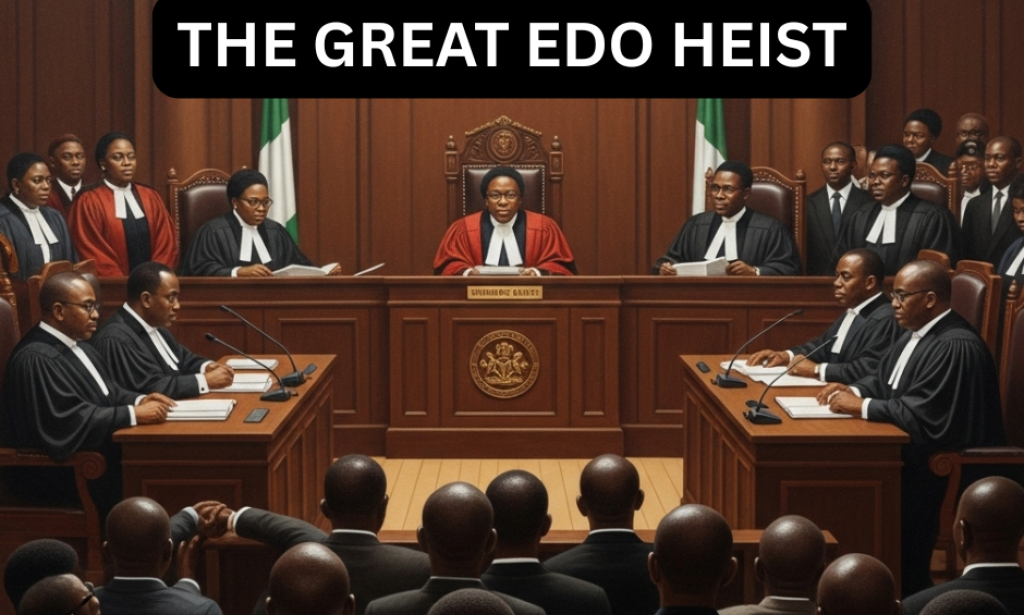

As Nigeria's Supreme Court prepares to deliver judgment tomorrow, July 10th, in the Edo State governorship election dispute, the nation watches with bated breath. The question is not merely about who governs Edo State, but whether Nigeria's judiciary still possesses any semblance of independence, integrity, or commitment to justice. The tribunal and appeal court's handling of this case represents nothing less than a calculated assault on electoral democracy and the rule of law.
A mockery of justice: How lower courts betrayed their constitutional duty
The Edo State Governorship Election Petition Tribunal, led by Justice Wilfred Kpochi, delivered what can only be described as a masterclass in judicial abdication. Despite being presented with 154 BVAS machines from 133 polling units, certified true copies showing glaring discrepancies, and forensic evidence that multiple result sheets were forged by a single individual, the tribunal dismissed everything as "dumped evidence." This wasn't jurisprudence; it was judicial malpractice.
The tribunal's April 2, 2025 judgment stands as a monument to everything wrong with Nigeria's electoral justice system. When faced with evidence of over-voting in 765 polling units – representing 16.7% of all polling units in Edo State – the tribunal chose technicality over truth. They demanded that petitioners produce witnesses to "explain" certified documents, brazenly ignoring Section 137 of the Electoral Act 2022, which explicitly states that certified documents can speak for themselves.
Even more damning was the Court of Appeal's May 29, 2025 decision. Justice Mohamed Danjuma's panel not only affirmed the tribunal's travesty but went further – they expunged the BVAS evidence entirely, claiming the tribunal had erred in even admitting it. This Orwellian logic – admitting evidence was wrong, but dismissing the case for lack of evidence was right – reveals the depths to which our appellate courts have sunk.
The evidence they refused to see
Let's be clear about what these courts deliberately ignored. The TAP Initiative's forensic handwriting expert, Jerry Wright-Ukwu, conclusively demonstrated that multiple Certified True Copies of result sheets were filled out by a single person. This wasn't speculation – it was scientific analysis that would stand up in any credible court of law. But not in Nigeria's election tribunals, apparently.
Yiaga Africa, one of Nigeria's most respected election observer groups, deployed 325 observers and concluded unequivocally: "The 2024 Edo governorship election fails the electoral integrity test due to lack of transparency in results collation process." Twenty-five election observer groups called it "the worst election since 2007." Yet the tribunal and appeal court pretended these assessments didn't exist.
Consider the Obozuwa Josephine case: an INEC Presiding Officer at Osholo Primary School Polling Unit allegedly allocated 352 votes to the APC when only 213 voters were accredited. This wasn't a clerical error – it was electoral fraud. Yet our courts found ways to look the other way.
A judiciary that betrays rather than upholds democracy
The leaked judgment controversy that emerged 48 hours before the tribunal's official pronouncement tells its own story. Documents suggesting a 2-1 split decision mysteriously became a "unanimous" judgment. The fact that such leaks occur with disturbing regularity in high-profile cases speaks to a judiciary that has become a tool for political manipulation rather than a guardian of justice.
When courts consistently dismiss election petitions on technicalities while ignoring mountains of evidence of electoral malfeasance, they cease to be courts of justice and become accomplices to electoral fraud. Since 2003, this pattern has repeated itself with nauseating predictability. No presidential election has ever been overturned. Governorship elections follow the same script: present evidence, watch it get dismissed on technicalities, appeal, lose again, and watch democracy die a little more.
Asue Ighodalo won this election – the evidence is overwhelming
The mathematics are simple. Monday Okpebholo was declared winner with 291,667 votes against Asue Ighodalo's 247,274 votes – a margin of 44,393. But when you subtract the proven over-voting in 765 polling units, when you account for the forged result sheets, when you consider the manipulation at collation centers documented by independent observers, the picture changes dramatically. Asue Ighodalo won this election, and every honest examination of the evidence confirms this fact.
The PDP presented 19 witnesses, over 1,000 documents, and forensic evidence that would convict in any criminal court. They demonstrated systematic manipulation of results, particularly in APC strongholds where vote tallies mysteriously exceeded accredited voters. Yet our courts demanded they produce the very INEC officials who perpetrated the fraud as witnesses. It's like demanding a robbery victim produce the robber as a witness to prove a robbery occurred.
A warning to the Supreme Court: History is watching
Justice Mohammed Garba Lawal and his panel stand at a crossroads. They can either perpetuate the judicial farce that has characterized this case or they can redeem Nigeria's judiciary from the abyss. The facts are clear, the evidence is overwhelming, and the law is unambiguous. Section 137 of the Electoral Act exists precisely to prevent the kind of technical gymnastics the lower courts employed to dismiss legitimate grievances.
If the Supreme Court validates this electoral heist, it won't just be stealing a mandate from the people of Edo State – it will be signing the death warrant of Nigeria's democracy. When citizens lose faith in the ballot box and the courts, when electoral fraud is not just perpetrated but judicially sanctioned, democracy dies and chaos beckons.
Justice Lawal's previous handling of election cases offers little comfort. The pattern of judicial deference to declared results, regardless of evidence, has become so predictable that electoral riggers now operate with impunity, knowing the courts will provide cover for their criminality.
The judges who failed Nigeria
Justice Wilfred Kpochi, who led the tribunal, will forever be remembered as the judge who looked at 154 BVAS machines showing electoral fraud and called them "dormant." Justice Mohamed Danjuma of the Court of Appeal will be recorded in history as the jurist who found admitting evidence of fraud was wrong but dismissing a case for lack of evidence was right.
These judges had the opportunity to stand on the side of justice, to protect Nigeria's fragile democracy, to give meaning to the votes of ordinary citizens. Instead, they chose the path of least resistance, hiding behind technicalities while democracy burned.
Justice A.B. Yusuf and Justice A.A. Adewole, who served on the tribunal, are equally complicit in this judicial tragedy. Their unanimous decision to dismiss clear evidence of electoral fraud represents a betrayal of their judicial oath and a surrender to forces that seek to destroy Nigeria's democratic foundations.
The cost of judicial cowardice
When courts refuse to confront electoral fraud, they don't preserve peace – they guarantee future conflict. Every stolen mandate, every validated fraud, every technical dismissal of legitimate grievances pushes Nigeria closer to the precipice. The judiciary was meant to be the last hope of the common man, the final arbiter of justice. In the Edo 2024 case, it has become the final nail in democracy's coffin.
International observers have largely abandoned monitoring Nigerian elections, knowing that regardless of what they document, the courts will find ways to validate fraud. Civil society organizations exhaust resources documenting irregularities that judges will deliberately ignore. Citizens risk their lives to vote, only to watch their votes nullified by judicial sleight of hand.
Tomorrow's judgment: Redemption or damnation?
As July 10th dawns, the Supreme Court has one last chance to restore faith in Nigeria's judiciary. The evidence is there: the forged result sheets, the BVAS machines, the over-voting, the independent observer reports, the forensic analysis. All that's required is courage – the courage to call fraud by its name, the courage to stand with the people against powerful interests, the courage to save Nigeria's democracy from those who would destroy it.
If the Supreme Court upholds the lower courts' decisions, it won't just be validating Monday Okpebholo's fraudulent victory – it will be declaring that in Nigeria, electoral fraud is not just tolerated but judicially protected. It will be announcing to the world that Nigeria's democracy is a sham, that votes don't count, that power belongs not to the people but to those who can manipulate results and count on judicial complicity.
History will remember
Every judge who participated in validating this electoral fraud will be remembered. Not as guardians of justice, but as undertakers of democracy. Not as defenders of the constitution, but as enablers of electoral criminality. Their names will be written in the annals of infamy, alongside those who sold their birthright for a mess of pottage.
Justice Garba Lawal and his panel have 24 hours to decide their place in history. Will they be remembered as the judges who saved Nigeria's democracy from collapse, or as the ones who delivered the final blow? Will they stand with Asue Ighodalo and the people of Edo State who voted for change, or will they join their colleagues in the hall of judicial shame?
The evidence is clear. The law is unambiguous. Asue Ighodalo won the Edo 2024 governorship election. Any judgment that says otherwise is not just wrong – it is a criminal validation of electoral fraud that will haunt Nigeria for generations.
Tomorrow, July 10th, 2025, Nigeria's Supreme Court will either resurrect hope in our democratic process or bury it forever. The choice is theirs, but the judgment of history will be ours. And history, unlike Nigeria's courts, does not forget those who betrayed justice when their nation needed them most.
You must be logged in to post a comment.