
NATIONAL ANTHEM & THE ANTITHESIS: Impenitence of a Nation where Talents Rot By ‘Tunji Ajayi
In National Pledge & Military Rulership (Punch, September 2, 1985) I submitted that: True and undisguised “loyalty, faithfulness and honesty” to a nation thrive only when a sense of belonging is instilled in the citizenry, and when given unrestrained latitude to partake in governmental affairs by airing opinions on socio-political issues, doing critiques of policies seemingly inimical to societal wellbeing, and offering alternative plausible suggestions. The view still remains sacrosanct. It can neither be through Twitter ban nor subtle threats to the media. A wise man makes sense even from foolish talk. Yes.
“The labour of our heroes past shall never be in vain.” So goes the promissory note of our National Anthem, as always sung everyday by altruistic and patriotic Nigerians; while the national flag hoisted around the four corners of the country flows in full mast. Nigerian politicians and leaders’ rendition often sound louder in their aristocratic baritone voices and at much higher crescendo enough to percolate the proverbial Jericho wall. That line often reminds this writer of Eric Donaldson’s sonorous lamentation in his lyrics entitled “Do we Really Have to Fight?”
Apparently puzzled by Africa’s multifarious but seemingly intractable problems, the Jamaican reggae songster lamented in a tone of disillusionment: “Shooting, Killing is now everywhere. Murder and backbiting . . . So do we really have to fight, to make it right?” And while reminiscing on the vain efforts of Africa’s past hero to right the wrong, the music maestro queried in a sorrowful tone: “Must all these great heroes die in vain, while we go straight into slavery once again?” Yes. Nigeria, the Giant of Africa and the most gifted nation in the continent, especially with unquantifiable huge natural resources has enslaved herself once again. Bob Marley surmises: “In the abundance of water a fool is thirsty.” Yes. While the Bible reminds us all that a borrower is a slave to his lender, the nation is sunk in huge debts, while in the midst of plenty. Her colonialist came but left her since 1960 to chart her course with the much-sought independence. They released us all to enjoy the supposed benefits of self governance. But like Fela hollered in his album, Colonial Mentality: “We don be slave before before. Dem don release you now. But you never release yourself.” Nigeria is still panting underneath the asphyxiating jackboot of the political elites who are leading us all into the doldrums, while mischievously chanting the national anthem emblazoned with the sacred promise that “the labour of our heroes past shall never be in vain.” Though they sing in sonorous voices with their unbridled strength a national anthem with great promise, but there remains a yawning gap between their walks and their talks.
Miguel de Cervantes, the 16th century Spanish dramatist and poet once reminded us that great success is never achieved through laziness. Putting his assertion quite pungently, Miguel wrote: “Diligence is the mother of good fortune; and the goal of a good intention was never reached through its opposite; which is laziness.” Having sung our national anthem and the good assurances therein for decades “to serve with heart and might, one nation bound in freedom”, the nation hasn’t truly been in peace and unity. Nigeria merely sings but doesn’t ponder and work on the lyrics of her song: “The labour of our heroes past shall never be in vain”. Good! But it remains to be seen whether Nigeria and her leaders are really working towards achieving that feat. Does the leadership provide exemplary character and work in consonance with the canons of our national anthem? Are the leadership’s actions not often incongruous with what the nation seemingly hope for; and which has made such hope remain forlorn since 1960?
Nigeria has her great heroes who had labored so relentlessly to have an independent and egalitarian state for the benefit of all. They are too numerous to mention here. Many labored without seeing the Nigeria of their dreams until they passed on and buried with their regrets. Some are still living and continue with the struggle. But if the dead ones were to resurrect today and find Nigeria in her present dismal state, would these heroes feel satisfied that the present crop of leaders who took over the baton from them, either forcefully through military intervention with vainglorious promises; or through democratic arrangements with highfalutin manifestos had lifted the country to higher pedestal for a better society and the benefit of all? Are the past heroes legacies preserved let alone improved upon? Has the country really progressed or retrogressed?
An event recently struck the attention of this writer which apparently suggests the level of pain and anguish the despicable state of this nation has inflicted on our living heroes’ psyche. It is most certain that if it were possible for the dead ones to rise up today, they would weep inconsolably and hurriedly run back into their graves in lamentation. The event under consideration aptly exemplifies the state of minds of the few living founding fathers of Nigeria who had been in the vanguards of establishing a truly democratic nation since 1979.
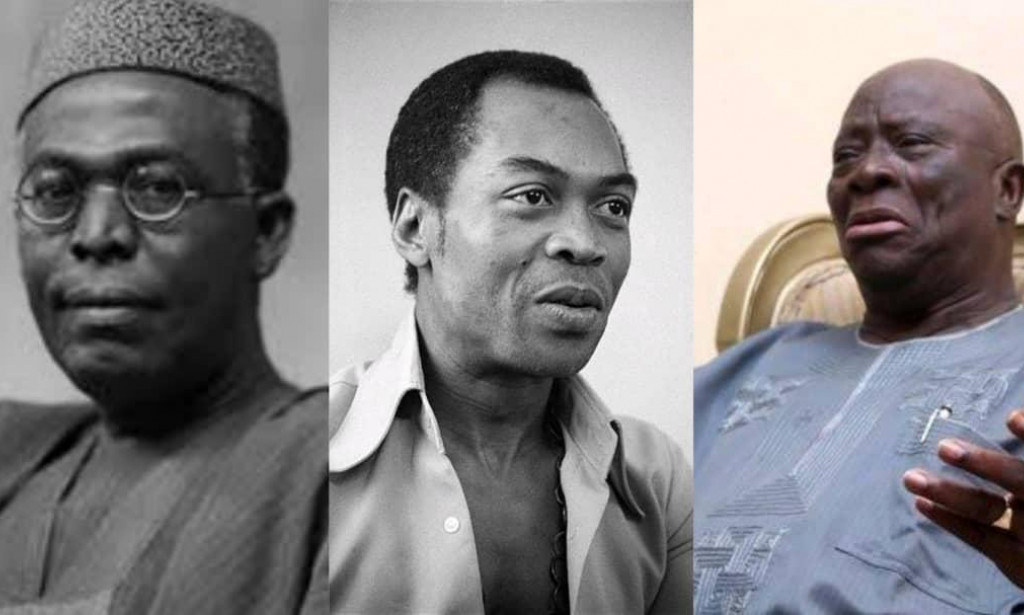
Pa Ayo Adebanjo is a well known activist on the Nigerian political landscape. But why does he merit our focus in this feature? In his treatise on the nonagenarian who was born on April 10, 1928 one of Nigeria’s finest writers Reuben Abati eloquently provided the biography of this Nigeria’s dogged freedom fighter in a newspaper feature entitled “The Man and his Politics” on his 90th birthday anniversary in 2018. Abati said of Adebanjo: as “a radical and progressive politician, a lawyer, elder statesman, a patriot, and a nationalist of Yoruba extraction, who is without doubt, one of the most remarkable politicians of his generation and a voice of reason in the Nigerian politics of the 20th century and early 21st century.” According to Abati, Pa Adebanjo “has lived through the finest and ugliest moments of Nigerian history: the constitutional processes, the struggle for independence, party politics leading to independence and after, the civil war, military rule, return to democracy, the struggle for the protection of democracy and civilian rule, and the bigger struggle of ensuring the survival and development of Nigeria. He joined the struggle early in 1943, as a Zikist, as a follower of Dr. Nnamdi Azikiwe but in 1951, he became a member of the youth wing of the Action Group, and a mentee and political disciple of late Chief Obafemi Awolowo. This became the defining moment of his life and 67 years later, he has remained faithful to the ideals of that political party and the ideology/political philosophy of his mentor – that is Awoism. As a member of the 1978 Constituent Assembly, and the 2014 National Political Conference, Adebanjo has been consistent in demanding a restructuring of Nigeria through the vehicle of a Sovereign National Conference.”
Pa Adebanjo’s quest for an ideal society has caused him to step on powerful toes thus sometimes curtailing his freedom. He was tried with the leader of the Action Group, Chief Obafemi Awolowo for treasonable felony in 1962 amongst 30 others. Adebanjo was charged but fled to Ghana. He had been detained many times on his political activism. A member of the National Democratic Coalition (NADECO) at the vanguard of the restoration of MKO Abiola’s mandate which was annulled on June 12, 1993 by General Babangida’s administration, he actively partook in street protests in defense of truth and justice, even at the expense of exposing himself and family members to the military despotism.
Pa Ayo Adebanjo clocked 93 years recently. But that did not deter his search for a better Nigerian state. In his press conference address entitled “Fixing Nigeria, Before The Fall” Adebanjo’s state of mind aptly reflected in the prologue of his press address, which should be of grave concern to every perceptive mind and lover of truth in this country. Hear the nonagenarian who spoke with candor and earnestness: “In the 93 years of God’s special Grace of my life, over 70 of which I have relentlessly spent in the struggle for a united, civilized, prosperous and Federal Republic of Nigeria; I have waited for some time in the departure lounge of life, and I owe it to posterity, to speak unalloyed truth to unconscionable powers, and to clarify the position of my people, the Yoruba of the Nigerian state, so that whenever I might be recalled home, it shall be said of me, that I not only did my bit, I indeed said my bit, and the position of the Yoruba people and Afenifere, were clearly and succinctly enunciated.”
Hmm! . . . “He who bears the interests of humanity in his breast, is richly blessed”, so says that Swiss educational reformer, Johann Pestalozzi. Pa Adebanjo had struggled for 70 years of his lifetime to see a better society up to and including the time he clocked 93 years. A thorough examination of his commentary reveals the mindset of a dogged freedom fighter who had shouted his voice hoarse to an impervious and impenitent authority on the saddle of power all his life, but painfully without any appreciable societal progress. Though, he remains unrelenting on his demands, but for now, and quite naturally at 93 he thinks more of the great beyond and legacies to leave behind as exemplified above. Nonetheless, Pa Adebanjo at 93 still musters enough courage and employing his waning energy to pull the ears of our leaders again, before the nation further drifts into the brink of precipice. Hear him as he hollered in psychological pain: “President Muhammadu Buhari and other political actors, blinded by ambition, may see the need to fix Nigeria before the imminent eclipse of her horizon. Nigeria is dying. . .”
Pa Adebanjo continued with emphatic stress on his altruistic request: “The Nigeria that was agreed is one that was deliberately federal in structure. The Nigeria that was agreed was by design, based on a parliamentary system of governance. The Nigeria that was agreed, was one that recognized the rights of the federating regions, to nationhood within the ambit of the federation that was birthed. The Nigeria that was agreed was not a perfect place, but neither is anything constructed by men; and the proof of its imperfections is embedded in the tragedies of the civil war that buried it.” Though Pa Adebanjo is still alive; may God grant him the grace to be around more. But perhaps our impenitent rulers would realize before it is far too late that true wisdom is learnt at the feet of the elders, many of who had passed on without seeing the Nigeria of their hope. Amongst these were Chief Obafemi Awolowo, Chief Nnamdi Azikwe, Alhaji Abubakar Tafawa Balewa, Mrs. Funmilayo Ransome-Kuti, Dr. Tai Solarin, Chief Gani Fawehimi, Prof. Ayodele Awojobi, Prof. Tam David West, Fela Anikulapo Kuti, Dr. Beko Ransome-Kuti, Dr. Obadia Mailafia, DCP Ben Odiase, Prof. Felicia Adedoyin etc. The list of Nigeria’s great heroes is endless and encyclopedic. But when we sing the National Anthem with verve and flair in high crescendo tone, do we honestly ponder whether Nigeria is working towards ensuring that “the labour of our heroes past shall never be in vain”?
Many of our young students might ask who are those above-mentioned personalities. This is especially due to poor preservation of our historical facts and archival materials, and also the mutilation of our school curriculum from which History subject was criminally removed. We may not get pissed off should any of them answer that Sir Frederick Lord Lugard was either a Chinese or American film actor, perhaps due to his athletic physique and unique moustache. We should not be surprised too if many of our young students do not know who late Pa Ben Odiase and Prof. Felicia Adedoyin were.
Pa Benedict Odiase was the composer of the present National Anthem which was adopted in 1978, and through which we and our rulers always made daily solemn promise that “the labour of our heroes past shall never be in vain.” On the other hand, Prof. (Mrs.) Felicia Adedoyin was the author of the National Pledge which the country recites daily; and by which allegiance to national cause to be “faithful loyal and honest, and to serve Nigeria with all our strength.” is emphasized as national ethos. Pa Benedict Odiase died on June 11, 2013 at the age of 79, while Prof. Mrs. Adedoyin died on May 1, 2021 at the age of 83. But here is the antithesis. This writer is yet to see any noteworthy things done to immortalize Odiase who, apart from being the composer of the National anthem, he joined the Nigeria Police in March 1954, and became the music director of the Nigerian Police Band, before he retired as a Deputy Commissioner of Police in 1992. Though Felicia Adebola Adedoyin was awarded the Officer of the Order of Niger (OON) in 2005 by the then Olusegun Obasanjo administration, it suffices to say that when Adeyoyin, a former University of Lagos teacher, professor of economics and a United Nation consultant died in May 2021, it took the youth wing of her town in Saki to appeal to the federal government to immortalize her while frowning that “condolence messages have been either delayed or scarce from relevant government authorities” almost 9 days after her demise.
As at 1998 Nigerians were still casting aspersion on China-made products, deriding them as inferior “Chinko” products. Very negligible few would buy them. Nonetheless, while the Giant of Africa keeps crawling like a sick snail, China goes ahead developing and encouraging the ingenious efforts of her youths, while Nigeria hardly pays any attention on her own teeming youths and thousands of graduates from colleges and universities. Millions are jobless, yet the country prays for peace and security. Today, China, the world’s largest population of over 1.4 billion conveniently feeds her citizens, while Nigeria wallows in the pang of death-dealing hunger, rearing cattle on the streets, airport tarmacs and public institutions. It prays against famine, yet little or nothing is done at the center to stem the menace of open cattle-grazing on the farms and agricultural plantations till today.
Leadership altruistic stance and sincerity to national cause breeds prosperity. China rose meteorically to become one of the industrialized and most powerful nations in the world, with unmatchable foothold on global economy and labour force. Though, a borrower remains a slave to his lender. China has not only grown to become a key lender to the Giant of Africa, now suffocation under huge debt burden, she also relies on Chinese technicians and technologies to develop her infrastructure. A nation that does not move ahead remains behind. China, with one of the largest submarines in the world ahead of Russia is now rubbing shoulders as a global super power with US, UK, Japan, Germany, USSR, etc.
China’s hitherto denigrated and slandered “Chinko” products of few decades ago have been perfected and dominating the global market today even in stiff competition with US and Japanese products. Her latest inventions and products are consumed virtually everywhere in the global market. While an average Chinese laments when 30 minutes of his productive time is lost in a day, which he considers a sacrilege, Nigeria has multitude of her talented youths who could transform the country in all spheres, but are losing billions of aggregate man hours yearly to traffic gridlock, and irregular electricity supply. Most Nigerians of 30 years age have never witnessed regular electricity supply since birth; while those with entrepreneurial skills, capable of engaging in meaningful jobs loiter about idly daily, unsure of how to survive economic hardship. In a country with leadership deficit, this may continue perhaps until they grow old and go back to the dust. It is unreasonable to expect prosperity from a country without good electricity supply and basic infrastructure. While our President, Ministers and foreign ambassadors are holding meetings and delivering eloquent speeches at international fora; chatting and exchanging banters on buffet dinners with world’s powerful rulers, let them pause and ponder on their possible estimation in the inner hearts of other leaders. It is evidently that of indiscreet leaders of one of the richly blessed nations in the world, merely praying in churches and mosques daily for leeway out of her doldrums, but yet refuse to provide patriotic and selfless leadership to transform their country. Nigeria clings lazily on a mono product, crude oil, as her economy mainstay decades after her independence. The rating is that of indiscreet leaders of a nation that refuse to harness her rich human resources and flagrantly allowing her great talents to rot away.
No sooner the Global System for Mobile communication (GSM) era came than our unemployed youths, most of them without formal education, started to dismantle and repair the sophisticated GSM phones and computers in their make-shift workshops. Hardly there is any brand they cannot repair today! Our mechanic villages are filled with technicians with ingenious and indigenous ideas on automobile technology. Chief Awolowo died with his great ideas on mass education for Nigerian youths. Prof. Ayodele Awojobi died with his "autonov" inventions untapped. MKO Abiola died in pursuit of a better Nigeria. Victor Uwaifo died with his ingenious designs. Fela died in endless request for equal rights and basic infrastructure for development. Gani Fawehinmi (SAN) died requesting for true democracy, justice and fairness for all. Today, the Abalakas of Nigeria are all advocating for home-grown herbal medicine like the Chinese, to reduce reliance on foreign drugs. Are our talents being recognized? Are our heroes not dying in vain?
May we continue to have vigor and non-discordant voice to sing the national anthem and chant the national pledge with unrestrained ardor. Amen. May we also continue to pray in mosques and churches for a better Nigeria. Amen. But noticeable success may remain elusive without acting on the tenets of the national anthem, and heeding the canon of the national pledge. Like the erudite speaker F. Emmanuel would say: “If you want to be in charge, be ready to embrace change” Until our leaders stop being impervious and learn wisdom from our present and past heroes, positive change may continue to be a mirage. And there is no hero in a defeated camp. Verbum Satis Sapienti.
+COURTESY: Ohio Wesleyan University Press, USA. --------------------------------------------------------- *’Tunji Ajayi, a creative writer, author, biographer and audiovisual documentary producer writes from LC-Studio Communications, Nigeria (+2348033203115, +2348162124412)

You must be logged in to post a comment.