
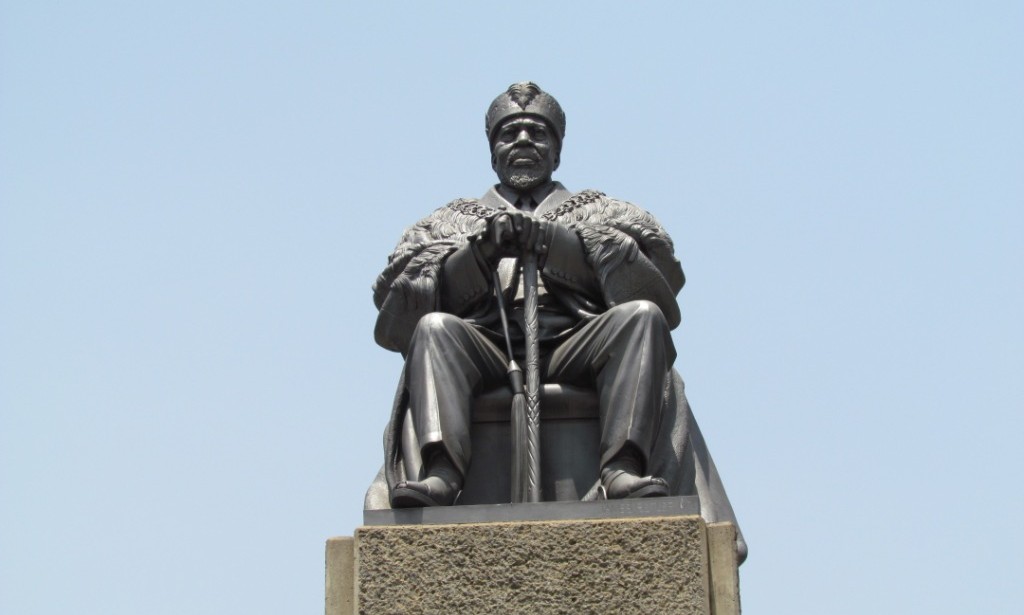
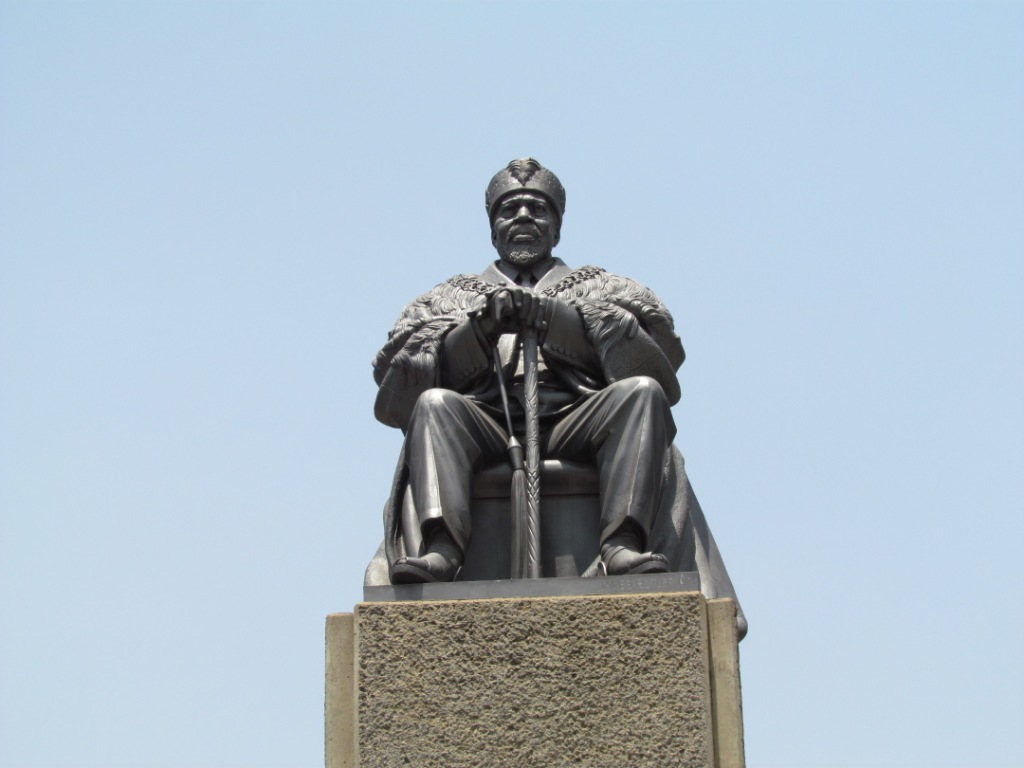
Is Jomo Kenyatta's first name Jomo derived from Maa i.e. "Shomo," or is it a combination of the names Johnstone Muigai?
Jomo appears to be a combination of the names Johnstone Muigai, even though Kenyans today in 2020, between the age bracket of about 50 years to 62 years, were during their time in primary school, taught that Jomo was a combination of the names Johnstone Kamau wa Ngengi. How does all this come about? He was born Kamau wa Muigai (Kamau son of Muigai) around the year 1896. His father was Muigai and his mother was Wambui. His father Muigai died when he was an infant, and his father's brother Ngengi inherited the young Kamau who now became Kamau wa Ngengi. He was baptised in 1914, now becoming Johnstone Kamau wa Ngengi.
His paternal grandfather i.e. Kung'u wa Magana (Kung'u son of Magana), was a Medicine-Man ("Mundu Mugo"), and he spent quite a bit of time with his paternal grandfather Kung'u wa Magana as a boy. One cannot say for sure, but it could be that he dropped his second and third names around the year 1928 and now instead became Johnstone Kenyatta, because of the significance he saw placed on the beaded Maasai belt "Kinyatta" by his paternal grandfather Kung'u wa Magana, who as mentioned was a "Medicine-Man" ("Mundu Mugo"). For much of the rest of his life he infact wore a "Kinyatta" around his waist, for good luck, apart from dropping his second and third names for "Kinyatta"/Kenyatta.
He attended the London School of Economics in England, where he studied Anthropology. His thesis fell due in 1938, which he submitted via his 1938 book "Facing Mt. Kenya," on Kikuyu Customary Law.
His supervisor at the London School of Economics was a world famous Anthropologist of those times known as Prof. Bronislaw Malinowski, and it appears to be Prof. Malinowski who advised him to further "Africanise" his names, so as to further "authenticate" him as a "true African," before the publication of his 1938 book "Facing Mt. Kenya," which as mentioned, also served as his thesis towards the award of a Diploma in Anthropology.
He thus dropped his first name Johnstone, now becoming Jomo Kenyatta. The 1938 book/thesis "Facing Mt. Kenya" is by Jomo Kenyatta, not by Johnstone Kenyatta, which appears, as mentioned, to have been prompted by Prof. Bronislaw Malinowski.
But why, all the same, does Jomo appear to be a combination of the names Johnstone Muigai?
In principle, it has all along been acknowledged that Jomo is as an abbreviation of his initial names, as mentioned, with regard to Kenyans today aged about between 50 years old and 62 years old, who were taught this during their time in primary school. If this was in dispute, then it is something that would have been long removed from the school curriculum in Kenya, because it was taught in Standard 7 Primary School Civics from around 1970 to 1982 i.e. for around thirteen years, about nine of which he was alive, and would therefore have directed the Ministry of Education to "stop peddling falsehoods and untruths."
He dedicates his said 1938 book "Facing Mt. Kenya" to his father Muigai and his mother Wambui, and in those days Muigai was spelt Moigai, and Wambui was spelt Wamboi. There are even those who still maintain that his paternal grandfather was Kongo, not Kung'u, because in those times too, Kung'u was spelt Kongo. There is even a one time Chairman of the Nairobi City Commission called Daniel Kongo, who has since converted to Islam and is now Omar Kongo, so the example of Omar Kongo, reinforces the standing that his paternal grandfather was Kongo, not Kung'u. Regarding the said Daniel Kongo/Omar Kongo, the City Council of Nairobi was disbanded in 1983 and replaced by the Nairobi City Commission, and the Mayor of Nairobi replaced by the Chairman of Nairobi City Commission. The City Council of Nairobi made comeback in 1993 following the 1992 elections, and the 2013 elections again replaced the City Council of Nairobi with the County Government of Nairobi. Omar Kongo (Omar Kung'u/Daniel Kongo), was one of those who served as Chairman of the Nairobi City Commission/Mayor of Nairobi, from 1983 to 1992.
Mbuguss and Beauttah are two other name variations of those times, albeit more in leaning to attempting to be Anglicised and Westernised e.g. a one time Editor-in-Chief of the Nation Media Group (then known as Nation Newspapers Limited), was known as George Mbuguss i.e. George Mbugua, and there is still a small pocket of Kenyan Kikuyus who go by the name Mbuguss rather than Mbugua.
Probably more dramatic is the example of James Beauttah i.e. James Mbuthia. James Beauttah i.e. James Mbuthia, not Jomo Kenyatta (then Johnstone Kenyatta), was actually the first choice of the Kikuyu Central Association (KCA) back in the year 1929, to go to Britain to table the grievances of Kenya's Kikuyu community to the British Secretary of State for the Colonies (Minister in charge of the Colonies), who at the time was either the Rt. Hon. Leo Amery or the Rt. Hon. Sidney Webb, but James Beauttah (James Mbuthia), declined the Kikuyu Central Association (KCA) offer because he had just landed a good job in neighbouring Kampala, Uganda, with the East African Postal Services.
In a sense, James Beauttah (James Mbuthia), went to his grave a bitter man, in a sense never quite forgiving himself for declining the Kikuyu Central Association (KCA) offer to represent the KCA in Britain in 1929, possibly feeling somewhere in him, that if he had accepted the KCA offer in 1929, he, rather than Jomo Kenyatta, would have later led Kenya to independence as Prime Minister.
The name Beauttah (Mbuthia) has however not stuck in Kenya, and only remains in use in the Beauttah family, unlike Mbuguss i.e. Mbugua, which has broader usage. Two of James Beauttah's (James Mbuthia's) most well known children are Steele Beauttah, a renowned Kenyan music artiste of the 1960s and 1970s, and Oscar Beauttah, who was to Kenyan television in the 1970s, what e.g. Jeff Koinange is to Kenyan television nowadays. In those days anyway i.e. the 1970s, there was only one television station and one radio station in Kenya i.e. Voice of Kenya (VOK), which in 1989 became Kenya Broadcasting Corporation (KBC). Oscar Beauttah (Oscar Mbuthia), was indeed a celebrity on Voice of Kenya (VOK) television back in those days.
Back to Jomo Kenyatta wa Muigai, also once known as Johnstone Kenyatta, also once known as Johnstone Kamau wa Ngengi, also once known as Kamau wa Ngengi, and also once known as Kamau wa Muigai.
He remained grateful to the Church of Scotland missionaries, Thogoto, Kiambu, Kenya, for enabling him attain literacy, for training him as a carpenter, and for finding him a job as a clerk at a Coffee Estate in Thika, Kenya, all this from around the years 1911 to 1913, which is why it appears he wanted to retain a component of the colonial legacy in Kenya in his identity i.e. by retaining the name Johnstone, or at least part of it, hence the birth of the name Jomo, apparently motivated by Prof. Malinowski mentioned above i.e. a combination of the names Johnstone and that of his father Muigai, and as mentioned, Muigai in those times was spelt Moigai.
Johnstone + Moigai = Jomo, rather than Jomo originating from Maa i.e. "Shomo," even though yes indeed, Jomo Kenyatta's paternal grandmother, Kung'u wa Muigai's wife, was a Maasai lady called Mosana.
Jomo does not also appear to be a combination of the names Johnstone Kamau wa Ngengi, as certain generations of Kenyans were taught in primary school from around 1970 to 1982.

You must be logged in to post a comment.