
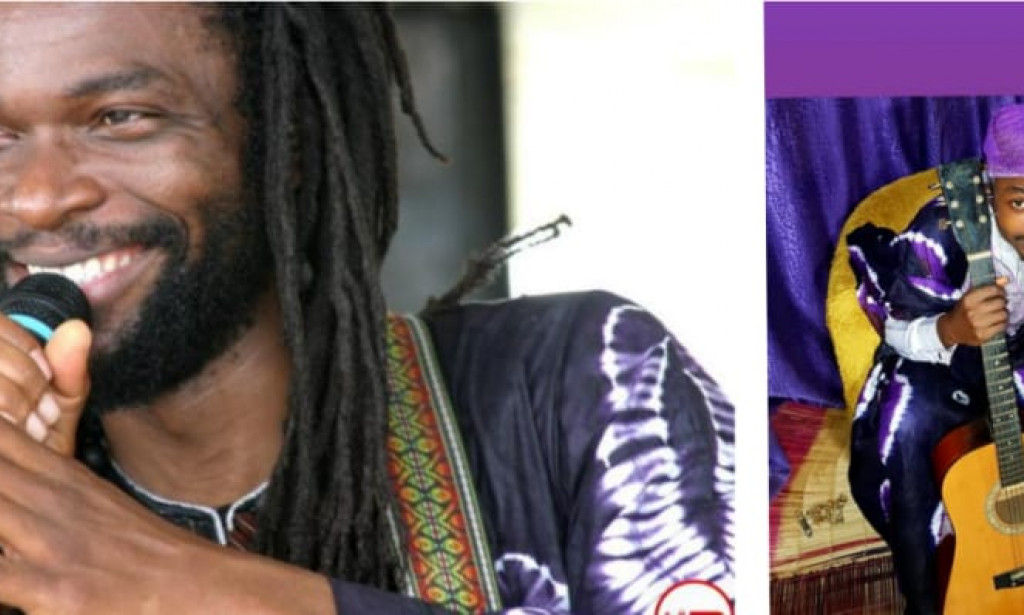
BEAUTIFUL NUBIA's ECLECTISM: Towards a Revival of Cultural Values & Talents Development By ‘Tunji Ajayi
His reticence, genial and unassuming bearing in private life belies the eclectic wonders he often performs on the musical podium. Indeed, it is a truism that the calm mien of the tiger is not borne out of fear. In Yoruba parlance, the witty ones would aver that “Yíyó Ekùn t’ojo kó”. Gadding effortlessly in the rendition of folk music to poetry; and from traditional roots music to afro beat all in one fell swoop, Beautiful Nubia is a wonder to behold on the Nigerian entertainment stage! A typical “Omo òdò àgbà” with uncommon native sense, and an avant-garde in the application of deep Yoruba philosophy, witticism, proverbs and oral poetry in musical communication, the artiste must have been a beneficiary of the aphorism which postulates that “wisdom is learnt at the feet of the elders”. His powerful and informative jibes at his Eniobanke Music Festival & Concert (EMUfest) recently revealed his being very close to his grand-mother in his youthful days. The Lagos Concert; one of the many which the effervescent artiste organized across Nigeria - the largest black population in the world, is premiered for the annual celebration of folk and roots music. Beautiful Nubia, real name Segun Akinlolu, often latches on deep philosophy and witticism which he eminently applies in virtually all his lyrics. A multi-instrumentalist per excellence and a very prodigious artiste with awe-inspiring musical art works, the artiste has cut his teeth in the rendition of his genre of contemporary folk & roots music. Leading his effervescent and cohesive Roots Renaissance Band, Beautiful Nubia’s numerous albums of many years double as a library of monumental values for the upcoming youths to learn wisdom, and also benefit from a trove of knowledge wherein lessons on originality can be learnt. His musical art works are so exhilarating to listen to in a convivial mood for partying, or for deep sober reflection on life’s travails, or to dissipate boredom of foisted stressful daily lifestyles. Often laden with proverbs, satire, folkloric tales, symbolism and witticisms, his rich lyrics as a powerful Yoruba anthology eminently confirm the veracity of William Congreve, the great English playwright and poet of the restoration era’s claim, who asserted in his Hymn to Harmony that “music alone, with sudden charms can bind wandering sense, and calm troubled mind.”
The Yoruba nation, South West Nigeria, comprise some of the most educated, pragmatic and revered people in Africa who enjoy good, indigenous music. Beautiful Nubia’s repertoire of poetic lyrics eminently satisfies the canon of good music, which should be potent enough to inform, educate and titillate to elicit positive reactions from the audience. For example C.M. Bowra, a Professor, literary critic and English classical scholar in his book Primitive Song writes inter alia: “Selection and energy go into the composition of primitive songs or poems . . . their makers are moved by a truly creative desire to make the most of something which presses urgently on them and demands to be fixed in memorable words.” Beautiful Nubia’s powerful, socially conscious protest lyrics can change the most impenitent heart for positive reactions. It can also provide needed succor for famished souls whose hopes are sinking into the nadir on daily basis especially in Africa. For example in his "Seven Lifes", the artiste enchanted his audience with a very scintillating voice, typical of rendering a somber elegy while he sang philosophically: “In my journey through the world, over land and over sea, I see different cultures and different people’s ways. I was born where the sun never sets and never rises. I was born where the heat is like a second skin.” Indeed in Africa, social and economic problems being faced by the people daily are like the metaphoric asphyxiating heat of the ubiquitous scorching sun which has gradually become part of our daily lives. At the nose of our complacent leaders are the downtrodden masses groaning under their jackboots. While their “Children are crying on the streets” the aristocrats and the avaricious politicians’ “automobiles are making noise” and oppressing the downtrodden. In the midst of our God-endowed natural resources “the land is growing dry and weak” while the oppressed “spirits are dying low.” But Nubia went further in his satirical lyrics: “The forefathers are calling me; saying ‘never tire, never weaken’. The pride in me is bursting loose. I am an African boy.” Beautiful Nubia, the great philosopher and poetic tale teller of our time recalled how his father on the farm also called him down behind a tree, for whom he prostrated to receive prayers at his feet. Hear him: “Then he told me all the stories of my brave ancestors. ‘Look into my eyes, son, you were born to be great.’” What a timely consolatory song from a lyricist, so potent enough to reverse the often suicidal instinct of a famished and depressed soul! Though, our land is truly ridden with poverty and squalor, Nubia, an avid writer, here reminded us to remember the stories about our ancestors’ bravery, and thus should keep the hope alive and move ahead, as only the living gives live testimonies.
Truly like Nubia sang, a typical dogged and indomitable African boy has “seven lifes” and undying spirit with which he struggles daily to eke out living and makes ends meet. However, it is hoped that African leaders will not take for granted the African boy’s patience for far too long by continually exploiting and oppressing him. The suppressed and suffocated African boy could soon react and demand for freedom, since the enslaved “African boy” already knows very well that lean freedom is better than fat slavery; and that prolonged silence is often misinterpreted to mean idiocy and complacency. Since the “Arab Spring” civil disobedience, and perhaps the “EndSARS” protests in Nigeria, the metaphorical “African boy” has revisited the 18th century Spanish revolutionary Dolores Ibarruri’s suggestion that “It is better for a man to die on his feet than to live on his knees.” African boy has realized that there is a limit at which forbearance seizes to be a virtue and beyond that level, forbearance becomes crass stupidity and docility. Through his satirical music, Beautiful Nubia the philosopher provides timely blandishments for the self-opinionated and impenitent African leaders’ benefits.
Like a troubadour, the artiste and avid writer who has traversed the Nigerian entertainment scene with untainted glamour and undiminished honour, is in the vanguard of revamping and reviving our lost cultural values and age-long traditions. The lyrical content of his music is sweeping and so didactic enough to offer useful lesson to our youths who are erroneously entangled in the web of westernized cultural and extraneous practices. Nigeria, and indeed the Yoruba race really need more great philosophers of Beautiful Nubia’s towering status, now more than ever before to pick up the gauntlets and pull our collective ears before our values totally fall into the brink of precipice. Our indigenous languages, cherished traditional practices and omolúàbí conducts are being denigrated and branded outlandish, while elder’s guidance and admonitions are treated with disdain and christened as “old-school” thoughts by many of our mentally colonized youths, with a concomitant effect of loss of moral compass and other dismal consequences. Our entire nationhood has wallowed in moral turpitude and socio-economic cul-de-sac largely due to the imperviousness and insensitivity of our egocentric leadership.
It is no wonder why Beautiful Nubia pulled our ears by reminding us of the historical omolúàbí traits; thus making the wise ones reminisce and develop nostalgic feelings for the good old days through his lyrics “Máa Bá Won Só” where he recalled: “Lójó ojósí, omodé kìí gbójú sókè w”àgbà, b’agbà bá n rojó, omodé a pa lóló ni”. It is true that in the olden days, the youths never dared stare pointedly at the elderly or despise them when discussing; but youths would rather keep silent and learn from elderly wisdom. And that must have led to the popular proverb: “Wisdom is learnt at the feet of the elders”. Whereas the youths, with their impressionable minds listened and learned wisdom from the elders back then, today they figuratively “stare” pointedly and directly at the eyes of the elders without regard for their wisdom and advice. And that obviously explains why we are where we are today, wallowing in a decadent society ridden with moral debauchery, mounting social vices and upheavals.
Beautiful Nubia who hosts yearly Eniobanké Music Festival, (EMUfest) which often includes musical concerts around the country, has consistently displayed undisguised philanthropic gestures by giving back freely to his society and the entertainment world. He is perhaps one of the few great artistes with genuine passion to develop young musical talents. Being in the audience at this year’s EMUfest Concert provided an exhilarating experience for this writer. The great artiste obviously is aware that true greatness is not only measured in terms of fame or wealth amassed for oneself, but in terms of how truly one has lifted others up from the doldrums. Indeed, a man is not truly great until he has genuinely replicated himself by making others happy and fulfilled. In a rare show of love for others, especially the budding musical talents, about 15 youths were invited as guest artistes in this year’s EMUfest. So far in the past eleven years when the festival was premiered, not less that over 400 artistes have benefitted from his philanthropic gestures. It is instructive to note that even great and established artistes had been invited by Eniobanke Music Festival boss to perform live in previous years’ EMUfest Concerts. The annual festival which debuted in 2010 had earlier featured veteran artistes including late Pa Chris Ajilo, the legendary Pa Jimi Solanke, the singer and songwriter Lagbaja. Others were the vocalist, dancer and lyricist Yinka Davies, EdaOto & The Afrogenius Band, et.al. Beautiful Nubia evidently puts into practice the teachings and sacred cannons of his music, which largely hinge on unpretentious love for others, equality and justice, better living standards for all, and better society for peace and equanimity. His unique habit is commendable, especially in our modern world beclouded by egocentric and “quid pro-quo” - “rub my back before I rub yours” phenomenon, where like most politicians, nothing is hardly done free without looking for higher gains in return. EMUfest has largely impacted on the youths by consistently supporting and promoting budding talents for decades now without counting the huge costs it entails. Like the corporate name implies “Eni tí Oba n ké” – (He that is being blessed by God), Beautiful Nubia’s blessings continue to multiply, since the givers hands often literally remains on the top. Like Bob Nesta Marley would say: “Who Jah bless, no man curse”. May the artiste blessings continue to flourish and quadruple.
Beautiful Nubia is amazingly prodigious. In his “Lamentation for a Broken Pot” – (Ìkòkò Àkúfó), Nubia tickles his audience auditory nerves by latching into deep philosophical thoughts, the hallmark of his ever-rich lyrics; wherein he tells us the real beauty of a woman who had home training and lovable characters. According to him, such a woman is like the adorable crown on her husband’s head whom he would always cherish and love deeply. Nubia sings with emphatic verve and flair: “Se b’á dé orí oko ni wón, obìnrin tó ní’wà tó léwà. Ìrírí òbí ni won ó maa jé. Obinrin tó gb’eko tó mu lò.” What an instructive homily for the women who cherish being deeply loved to note that when good character is lost, the beauty pales to insignificant value before the husband. For a woman who combines amiable characters with beauty, Nubia enthuses: “Orí re dára, orí re sunwòn, o dádùfé olorì oko. O dàbèfé o.” Which literally means that she had been counted lucky and worthy of deep honours, since the husband will deeply cherish her like a Queen. Otherwise, she metaphorically becomes a “broken pot” (ìkòkò àkúfó) which is evidently useless for preparing sumptuous soup; neither is it useful to fetch water from the river! - “Ìkòkò tó fó kìí se ohun àmú s’ebè. ìkòkò tófó kìí s’ohun àmú r’odò. And on a broken pot, Nubia the deep added a clincher: “It is meant for the garbage dump”!
Since “only the deep calls to the deep” like the late sage Chief Obafemi Awolowo once averred, Nubia is deep since he calls to the deep. In his “Small Peoples Anthem” Nubia dazzles the music world with his “Òrò ayé sòro. Òrò ayé mà le . . .” wherein he becomes deeply puzzled on why many people are suffering, and many are sad. Just like his fellow compatriot, the music maestro Jimmy Cliff similarly lamented many decades back, the perspicacious Nubia was visibly disturbed as evident from his somber and sober voice on why “too little people get everything and too many people get nothing.” Cliff back then made a plea to God to “remake the world”. And since our beleaguered society still remains in the same palpable and pitiable condition ever since, the empathetic and sympathetic Beautiful Nubia lamented that while some people could feed well, some couldn’t even get any food to eat. According to him, while some are dressed in beautiful and expensive latest fads, many are in rags. While some are amassing beautiful mansions as if they are yam tubers, there are many people sleeping under the bridges. While some live like kings and play God; some live like slaves. According to the artiste, while some are celebrating, some are ululating in grief. While innocent day-old babies die prematurely, the wicked and pernicious men live long lives. Hear Nubia as he beautifully presents a pedagogic music aptly depicting our world of antithesis and oddities!: “Awon kan lè je, awon kan ò ri je. Àwon kan n lo’so àsìkò. Àwon kan n sùn abé gádà, awon kan n to’lé jo bí isu. Àwon kan n j’oba awon kan n s’erú, awon kan n se bí Olódù marè . . . “
Our world of social and class stratification where, despite God’s endowed human and material resources, humanity still lives in the metaphorical ocean and wash their hands with spittle. This confirms the veracity of Bob Nesta Marley’s claim that while “fools die of want of wisdom”, knowledge and wisdom preserve its owners. Beautiful Nubia no doubt is a unique blessing to the entertainment world, having sung copiously on virtually every foible in a decadent society that requires constant prodding by the discerning minds before it moves further from its self-created crevices and quagmire to the deadly brink of precipice. Perhaps our music world, and our leaders would engage their perceptive eyes early enough to understand that a real African musical prophet is now right here in our midst and listen to his timely homily before it is far too late, so that our situation may not be like that of Jesus Christ’s adversaries, who failed to recognize the empathetic Saviour and listen to him; until the last minute when they were left in the abyss of regret, leading to endless crying and gnashing of their teeth.
The amazingly sizzling Lagos Concert which was well attended by many music buffs, Beautiful Nubia’s fans, music scholars etc, had greatly talented and budding artistes in diverse arts and acts as guests. They all performed excellently well and thrilled the audience without let up. They included Iwari, BJ Computa, Ayomide Africa, Aanu the Guitarist, and Adejoke Raji-Adenowo the Poet.
The precocious Adédàmólá, a multi-instrumentalist, rapper, singer and music producer, opened the sizzling Live Concert with his scintillating tracks: “Yabis” which suggests antidotes for the socio-political travails of our beleaguered society; followed by the track “Elétè” which decries lack of leadership focus on their responsibilities to the people, and “Fear of God” the lack of which is obviously our main societal albatross today. The prodigious Beautiful Nubia himself, who has just released a whopping 28-track chartbuster album entitled “Huruhara”, rounded off the memorable Concert with his deeply philosophical and satirical lyrics emblazoned in alliteration and tongue-twisting play-on-words with his mind-blowing “Dágigé, dágigé, àáké kan ò dá’gi gé. Dágidà dágidà, Idà kan ò lè dági dà . . . “ Perhaps our impervious African leaders would appreciate that only constant consultations with the people that elected them into office can truly pivot democratic governance into safety, as the wishes of the people remains the legitimate foundation of any government, and not insensitivity to their cries. According to Beautiful Nubia in “Dágigé, dágigé” only one axe cannot easily fell a tree, while only one sword, no matter how sharp cannot also cut a log of wood easily; lest it imposes on itself the needless excruciating stress and pain of doing the task alone. “Two good heads”, the wise say, “are better than one.” After all, “àgbájo owó la fi n sò’yà. Enìkan kìí jé àwa dé.” Truly, only the five fingers that jointly make up a hand are enough to beat the chest. And only a single individual cannot respond to a clarion call for a group task. Perhaps when we all realize this truism on the beauty of communal living, our society will truly move forward. Verbum Satis Sapienti. ------------------------------------------------ *’Tunji Ajayi, a creative writer, author, biographer and audiovisual documentary producer writes from LC-Studio Communications, Nigeria (+2348033203115, +2348162124412)

You must be logged in to post a comment.