
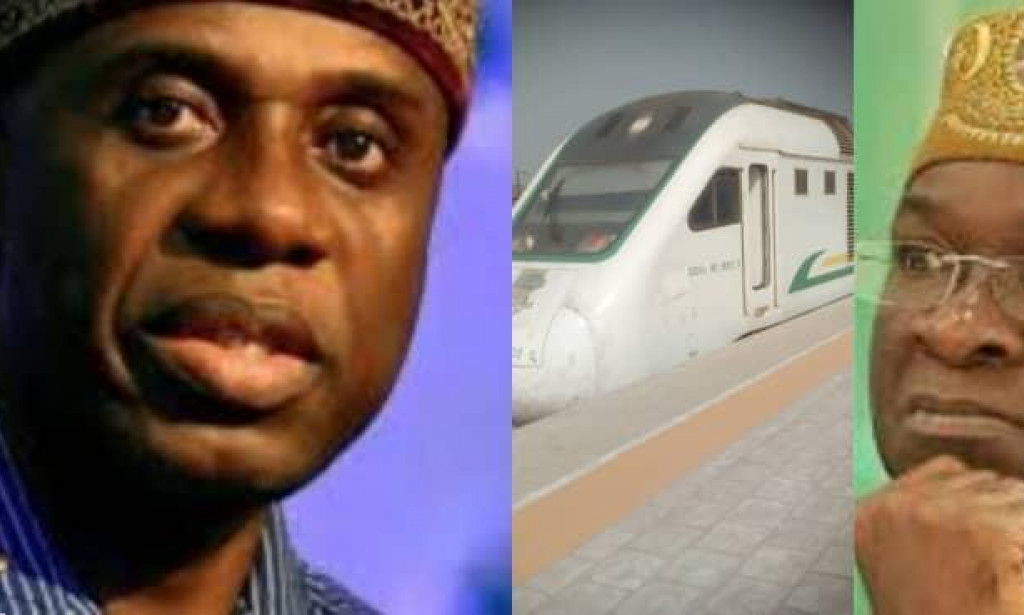
AMAECHI’S PROHIBITIVE RAILWAY FARE & FASHOLA’S WALL-CLOCKS’ CLOAK OF SECRECY
By ‘Tunji Ajayi
I have never stopped loving the Minister of Transportation, Chief Chibuike Rotimi Amaechi. Not because he has worked relentlessly to install semi-effective railway transportation network in the country but because of one simple fact. Transportation involves fluidity of movement of vehicles, haulage and human traffic across the length and breadth of a geographical space. Nigeria hasn’t got that yet. But this is not to suggest that our Minister has not made remarkable impacts on the provision of infrastructure in this regard. Our transportation system may not have been wholly fluid and reliable, but Amaechi’s fluidity of expression makes him an interviewer’s delight any day. If my main tools for creative writing are words, I should know what I am talking about. Often imbued with unmatchable confidence and poise, his degree of elocution and eloquence could win a coveted award in any competition anywhere. And I love him for that.
Sophism is an art in human communication. A sophist can effectively convince an unwary audience that black is white, or that it is the goat that metamorphoses into a lion. But without being skilled in sophism – an art in cunning, deception and ambivalence, an eloquent speaker could also achieve great feats without employing sophistry. If Amaechi has his own divine gift in elocution and eloquence, his counterpart Mr. Babatunde Raji Fashola has his own gift in erudition. Every leader needs a measure of erudition, elocution and eloquence to feed back his followers. But a reticent, recluse and in-eloquent leader’s carriage is often repugnant to the audience, and his public image and ratings unattractive. But both Amaechi and Fashola are bestowed with elegant carriage, attractive mien and panache of suave leaders. And let’s all appreciate them for that.
The cerebral Minister for Works & Housing whose workaholic disposition has largely contributed towards gradual pulling our hitherto moribund railway transportation system out of the doldrums is always delightful to watch and hear, as he often latches on his wits with logic typical of a legal luminary; while also applying exposition and his “argumentum-ad-verecundiam” and allied trademarks of an urbane legal pundit to pulverize opposition or interviewers’ claims to convince us by all means possible what the ideal infrastructural service provisions in a nation should be. Undoubtedly both Amaechi and Fashola are eminently worthy of double honours in the art of logical presentation of facts and workaholic instinct. A speaker might be eloquent, but his argument may lack needed bites to convince listeners, if his delivery is bereft of logic and elocution. Notwithstanding the prevalent lacunae in the transportation system, our Minister of Transportation and the Minister for Works & Housing are diligent men with unbridled robust capacity for hard work.
In 2018, President Muhammadu Buhari had said of the ongoing standard gauge railway project “We understand that this interconnectivity will improve the country’s economic competitiveness as targeted under the Economic Recovery and Growth . . . I have directed that every port must have the complement of rail infrastructure and our projection is that by the end of 2021, we will have standard gauge railway across the main North-South trading route.” Though not fully operational in all the routes yet, the new railway transportation project being installed by the China Civil Engineering Construction Company (CCECC) up to this present stage remains a beauty to behold and cherish. What with the smashingly beautiful administrative blocks, convenient waiting lounge, modern luggage scanners, toilet facilities etc. Amaechi and Fashola’s untiring efforts deserve huge commendations. While not losing sight of the huge cost of the installations nonetheless, no matter humongous fund dispensed on a project, it is human’s resourcefulness and genuine inputs that lend vitality to the institutions on which such resources are deployed. With the exception of occasional human errors, civil servants bureaucracies and the stereotyped lackadaisical attitudes towards government works and crass slackness of officials, the installation of allied facilities at the terminuses of the standard gauge railway facilities for the 157km Lagos-Ibadan line, and the 187km Abuja-Kaduna standard gauge is of immense benefits to the commuters.
The railway transportation is expected to complement the road transportation and help in reducing pressure and high rate of accidents on our roads due to congestion. It will also remove commuters stress due to traffic gridlocks on our pothole-infested roads. This is especially so on the Lagos–Ibadan notorious traffic as many travelers and road users now have a choice between traveling by road or the modern railway transportation system. Passengers had often been held up for hours on daily basis, an ordeal which this writer had experienced several times! Lagos to Ibadan is about 120 kilometer - a less than 90 minutes drive.
In “Tarrying and Tardiness, Lesson from Babes & Suckling” (see Ohio Wesleyan University Press, USA. October 28, 2019) I wrote: “Having been held up and became stranded on the so called Lagos – Ibadan “express way” into gridlock recently; I felt disconcerted, hungry and famished. I gave up the hope of ever reaching my office in Lagos having spent almost five hours from Abeokuta axis. I pulled out from other thousands of vehicles with commuters suffering similar fate like me, and decided to recline in a nearby village at the precinct of the express way. Sitting down underneath the shade of a tree overlooking the pothole-ridden express way, I fed myself with some roasted maize which I ate voraciously to dissipate my hunger. I hated myself dropping few grains on the dusty ground despite the intensity of my hunger.”
“Stretching my hand to pick them from the floor, it pained that my memory referred me to this rule of hygiene which my finicky hard nose teacher taught me in the primary school. Oh God! Why remembering his distasteful sermon: “wash your hands before eating and never feed on dropped food from the ground” now while under the pang of hunger. I threw the grains off albeit reluctantly, even though doing so was a painful decision . . .”
Indeed, long before the scourge of daily kidnapping, this writer having been stranded had slept overnight on the dreaded road that has now assumed higher notoriety for kidnapping and banditry. In that quoted piece above I averred interalia: “Though the Lagos-Ibadan Expressway reconstruction was flagged off on July 5, 2013 by Mr. President (then President Goodluck Jonathan) we hope the N167 billion earmarked for the reconstruction will achieve the goal it is originally meant. Let us all rise and pray that this will not end up like previous ceremonial flag-offs.”
But typical of many other projects in the past, Nigerians waited patiently as always till 2021 when Mr. President promised the rail transportation project would be completed. By this year 2022 while Nigerians are still expecting that the Lagos–Ibadan expressway which commenced far back in 2013 be completed, the Railway project partial completion came in as immense relief to many Nigerians. The Abuja–Kaduna pot-hole ridden expressway had also yet to be completed when the standard gauge railway came as succor in the axis. It is worrisome that a major road that connects Kaduna State to the capital city of Nigeria has remained in a decrepit state since the nation’s capital was moved from Lagos to Abuja in 1991.
However, the railway transportation fare still appears prohibitive for an average struggling Nigerian. For example theLagos - Ibadan First Class 24-Seater coach attracts a whopping sum of N6,000; the 56 and 68-Seater Business Class coaches attracts transportation fare of N5,000 and N3,500 respectively; while the 88-Seater Economy class is N2,500. On the other hand, Abeokuta-Ibadan trip in 24-Seater First Class Coach is N3,000, while the 56 and 68 Business Class attracts N1,500 and N1,000 respectively while the 88 seater economy class attracts N600. It is however curious why Abeokuta to Lagos Economy class - which is almost midway between Lagos and Ibadan attracts a whopping N2,000. Aside from the general prohibitive fares, the Abeokuta to Lagos fare obviously needs a drastic downward review.
However, the Kaduna to Abuja transport fare regime was put as First class normal trip: N2,500. Economy normal trip: N1,300. Economy “express” trip: N1,500. This was later reviewed upwards to N6000, N5000 and N3000 for First class, Business class and Economy class respectively to enable the government “meet the running costs”. While the Federal Government efforts in restoring the railway transportation system is commendable, however since the ultimate of governance is assuaging the sufferings of the citizens, it is incongruous and contrary to norms to keep shifting the burdens of governance to the same people already in anguish and crying for succor. The present prohibitive transport fares especially for the Economy Class often patronized by the poor masses should be reviewed downwards to compare with the public road transport fares.
While the government is determined to “meet running costs”, a Yoruba adage however should remind us all that a malnourished and lean baby’s health status cannot be reversed by a single day feeding - “A kìí f’ojó kan bó omo tó rù sanra.” The cost of the installed infrastructure cannot be recouped in a day. Governance which is aimed at providing social services to ameliorate citizens’ anguish and lamentations should be differentiated from private business entrepreneurship which runs on the sole objective of profit making. And this explains why advanced economies around the world often subsidize social services provision.
In Fela’s album entitled “Power Show” the perspicacious music maestro depicts the arrant show of power and the typical casual attitudes of the average Nigerian civil servant as exemplified in Fela’s allusion of Immigration Officer’s penchant to puff up with arrogance; while wasting travelers’ time at the border. According to Fela, “he go bluff you, waste your time; change him pen, comb him hair and tidy dem table, then pull him char.” Fela continues: “Then him go go for shit. And him go shit come back, before telling you later say you no go cross border today.” Fela hollered on: “Go to Post Office na the same” where the officer “go run you up and down, he go tire body, and tire your mind, before telling you that there is no change of 50 kobo.” We are still faced with similar “Power Show” ordeal in our government offices and parastatals till today. For God’s sake, in these days of information technology that aims at solving problems and facilitating work flow, why is the Nigerian Railway management still employing manual sales of tickets, which requires passengers physical presence in ticketing office, and the attendant long queue of passengers? This appears bizarre and incongruous with the realities of our IT age. Aside from exposing travelers to undue stress and strain, manual ticketing is fraught with fraudulent acts. Thus, it is high time the management introduced online air ticket procurement as obtained in air transportation services. On-line ticket sales reduce the “our ticket has finished “syndrome,even when the office hadn’t sold to passengers for 10 minutes, especially during festive periods when cases of ticket racketeering had often been alleged.
Like Samuel Odewumi, a professor of Transport & Environment, and Dean, School of Transport, Lagos State University, Nigeria once affirmed: “The best approach is to outsource the management. Transport management and operations globally is partly run as a social service; it can hardly survive strictly as business venture. But the worst form of corruption and greed by our public servants compounds our own situation. It is sad but true that our capacity to manage any of the public transport modes is grossly inadequate on account of our corrupt tendencies.”
In the newly released compendium on one of the greatest artistes of this generation entitledKING SUNNY ADE THE LEGEND!: Cultural Values & Philosophies Behind a Genre of African Music”, I averred in the preface the extent at which creative writers the world over could be so querulous. Here again on my recent trip from Ibadan to Lagos by the railway, I was confused and wasn’t really sure and satisfied about my actual understanding of what the seemingly simple word “Clock” means. Oh, you are surprised? Permit me to say that I don’t care. Thus, I was inclined to check the dictionary meaning and only became convinced that my understanding of the meaning was after all accurate, when theLongmans Dictionary of Contemporary Englishaptlyconfirmed my thought. Hear lexicographer Longmans: “An instrument that shows what time it is, in a room or outside on a building.” Interestingly, the dictionary gives an example thus: “The Station Clock was 10 minutes slow”. In the case of our new railway stations, it would have even been better if the Clocks were slow for 10 minutes or more. It is a worse case. In virtually all our new railway terminuses, there seems to be a cloak of secrecy from the lethargic but beautiful Clocks in all the waiting lounges to be inactive and useless. How so? Virtually all the Wall Clocks from Lagos-Yaba terminus to Agege to Abeokuta to Ibadan are not functional and static. None works! Even within the same station they spot different, inaccurate time! If Wall Clocks are installed there for a purpose, they are yet to serve the purpose. Rather, they are confusing passengers by communicating wrong time. Railway terminuses are like the entry-ports being en-route other places, and observed by tourists from all over the world including first-time visitors. And there is no second chance to make a first impression. I hope the fable is not true that when a man runs his daily activities and timing on stagnant, non-functional wrist watch or wall clock he may not likely move forward and make progress. And he that does not move forward remains behind. Verbum Satis Sapienti.
NOTA BENE: Bumper Promo by Amazon.com on the Book: “KING SUNNY ADE THE LEGEND! – Cultural Values & Philosophies Behind a Genre of African Music” – a whopping 56% off the $95.00 Cover Price to buy @ $42.75 for personal & academic libraries, culture & tourism depts. worldwide, great fans, music buffs etc. Get your copy via: https://amzn.to/3FD5fi3
……………………………………………..
*Tunji Ajayi, a creative writer, author, biographer and audiovisual documentary producer writes from LC-Studio Communications, Nigeria (+2348033203115, +2348162124412) Facebook: https://www.facebook.com/tunji.ajayi.946

You must be logged in to post a comment.