
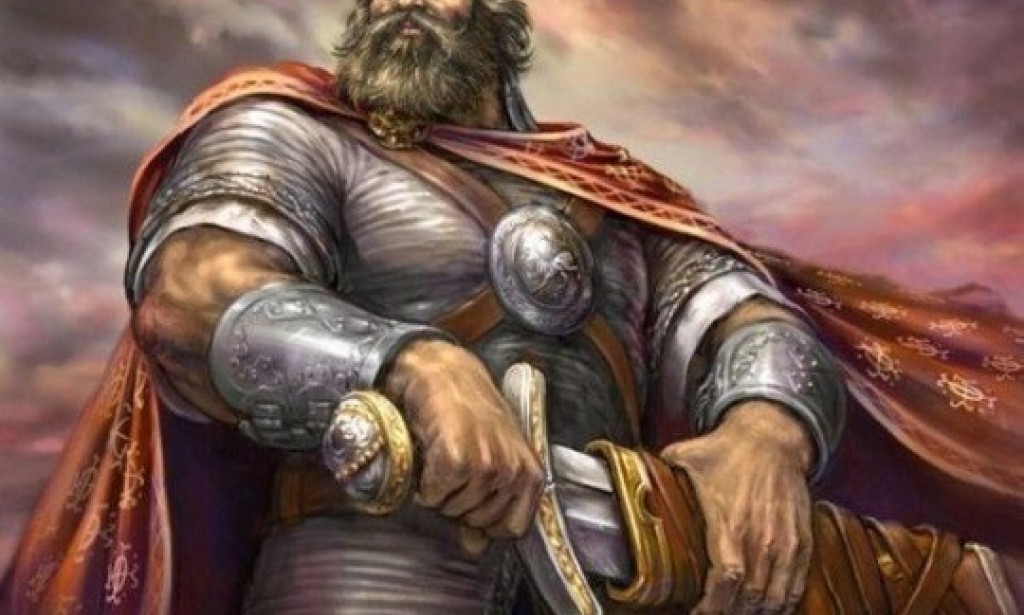
Colonel Karjagin’s campaign against the Persians in 1805 does not look like real military history. It looks like a prequel to the “300 Spartans” (40,000 Persians, 500 Russians, gorges, bayonet attacks, “This is crazy! - No, this is the 17th Jaeger Regiment!”). The golden, platinum page of Russian history, combining the massacre of madness with the highest tactical skill, amazing cunning and stunning Russian arrogance. But first things first.
In 1805, the Russian Empire fought with France as part of the Third Coalition, and fought unsuccessfully. France had Napoleon, and we had the Austrians, whose military glory had rolled back by that time, and the British, who never had a normal ground army. Both of them acted like complete losers, and even the great Kutuzov, with all the power of his genius, could not switch the channel “Faile for Faile”. Meanwhile, in the south of Russia, the Persian Bab Khan, with a purr of reading reports on our European defeats, appeared Ideika. Baba Khan stopped purring and again went to Russia, hoping to pay for the defeats of the previous, 1804. The moment was chosen very well - due to the usual production of the usual drama "The crowd of the so-called Krivorukov-allies and Russia, which again tries to save everyone," Petersburg could not send a single extra soldier to the Caucasus, despite the fact that the whole Caucasus was from 8,000 to 10,000 soldiers. Therefore, upon learning that to the city of Shusha (this is in present Nagorno-Karabakh. Azerbaijan, yes? Left-to-bottom), where Major Lisanevich was with 6 companies of rangers, 40,000 Persian troops are under the command of Crown Prince Abbas Mirza (I want to think that he was moving on a huge golden platform, with a bunch of freaks, freaks and concubines on gold chains, just like Xerxes), Prince
Tsitsianov sent all the help that he could send. All 493 soldiers and officers with two guns, the superhero Karyagin, the superhero Kotlyarevsky (which is another story) and the Russian military spirit. They did not manage to reach Shushi, the Persians intercepted ours along the road, near the Shah-Bulakh River, on June 24. Persian avant-garde. A modest 10,000 people. Not at all bewildered (at that time in the Caucasus, battles with less than tenfold superiority of the enemy were not considered battles and officially took place in reports as "exercises in conditions close to combat"), Karyagin built up an army in a square and repelled the futile attacks of the Persian cavalry all day , while from the Persians there were no lumps left. Then he went another 14 versts and stood in a fortified camp, the so-called Wagenburg, or, in Russian, a walk-city, when the line of defense was built from convoy carts (given the Caucasian impassability and the lack of a supply network, the troops had to carry significant supplies with them). The Persians continued their attacks in the evening and fruitlessly stormed the camp until nightfall, after which they made a forced break to clear the piles of Persian bodies, funerals, crying and writing postcards to the families of the victims. By morning, after reading the manual “Military Art for Dummies” sent by express mail (“If the enemy has strengthened and this enemy is Russian, do not try to attack him in the forehead, even if you are 40,000, and his 400”), the Persians began to bombard our walk -the city with artillery, trying to prevent our troops from reaching the river and replenishing water supplies. The Russians in response made a sortie, made their way to the Persian battery and blew it to hell with a dog, dropping the remnants of the cannons into the river, presumably with malicious insulting inscriptions. However, this did not save the situation. Having won another day, Karjagin began to suspect that he would not be able to kill the entire Persian army with 300 Russians. In addition, problems began inside the camp - Lieutenant Lisenko and six more traitors ran over to the Persians, the next day 19 more hippies joined them - thus, our losses from cowardly pacifists began to exceed the losses from inept Persian attacks. Thirst, again. Heat. Bullets And 40,000 Persians around. It’s uncomfortable. Two options were proposed at the officer’s council: or do we all stay here and die, who is it? No one. Or we are going to break through the Persian encirclement ring, after which we STORM the nearby fortress while the Persians are catching up with us, and we are already sitting in the fortress. It's warm there. Good. And the flies do not bite. The only problem is that we are not even 300 Russian Spartans, but in the region of 200, and they are still tens of thousands and they are guarding us, and all this will be like the game Left 4 Dead, where a tiny squad of surviving rods and rods of crowds of brutal zombies . Left 4 Dead everyone loved already in 1805, so we decided to break through. At night. Having cut the Persian sentries and trying not to breathe, the Russian participants in the program “To stay alive when you can’t stay alive” almost left the encirclement, but stumbled upon a Persian trip. The chase began, a shootout, then again the chase, then ours finally broke away from the Mahmuds in the dark-dark Caucasian forest and went to the fortress, named for the nearby river Shah-Bulakh. By that time, around the remaining participants of the insane “Fight as much as you can” marathon (I remind you that it was the FOURth day of continuous fights, sorties, dueling with bayonets and nightly hide and seek in the woods) the golden aura of the end was shining, so Karjagin simply smashed the gates of Shah Bulakh with a cannon core, and then tiredly asked the small Persian garrison: "Guys, look at us. Do you really want to try? Is that right?" The guys understood the hint and fled. During the run, two khans were killed, the Russians barely had time to fix the gates, as the main Persian forces seemed concerned about the loss of their beloved Russian detachment. But that was not the end. Not even the beginning of the end. After an inventory of the property remaining in the fortress, it turned out that there was no food. And that the convoy with food had to be thrown during a breakthrough from the environment, so there is nothing to eat. Absolutely. Absolutely. Absolutely. Karjagin again went to the troops: -
Friends, I know that this is not insanity, not Sparta, and generally not something for which human words were invented. Of the already miserable 493 people, 175 of us were left, almost all were injured, dehydrated, exhausted, to the utmost degree of fatigue. There is no food. No convoy. Cores and ammo run out. And besides, right in front of our gates is the heir to the Persian throne, Abbas Mirza, who has already several times tried to storm us. Do you hear the grunts of his hand freaks and laughter of concubines? He waits until we die, hoping that hunger will do what 40,000 Persians could not do. But we will not die. You will not die. I, Colonel Karjagin, forbid you to die. I order you to collect all the impudence that you have, because tonight we leave the fortress and break through to ANOTHER FORTRESS, WHICH AGAIN WILL TAKE THE STORM, WITH THE WHOLE PERSIAN ARMY ON SHOULDERS. And also freaks and concubines. This is not a Hollywood action movie. This is not an epic. This is Russian history, chicks, and you are its main characters. Put on the walls of the sentries, which all night will echo with each other, creating the feeling that we are in the fortress. We come out as soon as it gets dark enough! They say that in Heaven there used to be an angel who was responsible for monitoring impossibility. On July 7, at 10 p.m., when Karyagin stepped out of the fortress to storm the next, even greater fortress, this angel died of bewilderment. It’s important to understand that by July 7 the detachment had been fighting continuously for the 13th day and was not so much in the state of “terminators as” as in a state of “extremely desperate people moving on anger and fortitude alone into the Heart of Darkness of this crazy, impossible, an incredible, unthinkable trip. " With guns, with carts of the wounded, it was not a walk with backpacks, but a big and heavy movement. Karyagin slipped out of the fortress like a night ghost, like a bat, like a creature from That, the Forbidden Side - and therefore even the soldiers who remained to call on the walls managed to get away from the Persians and catch up with the detachment, although they had already prepared to die, realizing the absolute mortality of their task. But the Peak of Madness, Courage and Spirit was still ahead. Moving through the darkness, hassle, pain, hunger and thirst, a detachment of Russians ... a soldier? Ghosts? Saints of war? he ran into a moat through which it was impossible to transport guns, and without guns the assault on the next, even better fortified fortress of Mukhrati, had no meaning or chance. Forests to fill the moat were not around, there was no time to look for the forest - the Persians could overtake at any moment. Four Russian soldiers - one of them was Gavrila Sidorov, the names of the others, unfortunately, I could not find - silently jumped into the ditch. And lay down. Like logs. Without bravado, without talking, without everything. Jumped down and lay down. Heavy guns drove right over them. Under the crunch of bones. Barely moaning pains. An even bigger crunch. Dry and loud, like a rifle shot, crackle. The dirty heavy cannon carriage splashed red. Russian red.
Only two rose from the moat. Silently. On July 8, the detachment entered Casapet, for the first time in many days, normally ate, drank, and moved on to the Mukhrat fortress. For three versts from her, a detachment of a little more than a hundred people attacked several thousand Persian horsemen, who managed to break through to the cannons and capture them. In vain. As one of the officers recalled: “Karyagin shouted:“ Guys, go ahead, save the guns! ”Everyone rushed like lions ...". Apparently, the soldiers remembered what price they got these guns. Red again sprayed on the carriages, this time Persian, and sprayed, and poured, and poured carriages, and the ground around the carriages, and carts, and uniforms, and guns, and sabers, and poured, and poured, and poured until until the Persians fled in panic, and failing to break the resistance of hundreds of ours. Hundreds of Russians. Hundreds of Russians, Russians like you, who despise your people now, your Russian name, Russian nation and Russian history, and allow yourself to silently watch the power rotting and falling apart, created by such a feat, such superhuman tension, such pain and such courage. Lying in a ditch of apathetic pleasures, so that guns of hedonism, fun and cowardice walked and walked along you, crumbling your fragile shy skulls with their wheels of laughing abomination. Muhrat was taken easily, and the next day, July 9, Prince Tsitsianov received a report from Karjagin , immediately came forward to meet the Persian army with 2300 soldiers and 10 guns. On July 15, Tsitsianov defeated and drove out the Persians, and then joined with the remnants of the detachments of Colonel Karyagin. Karyagin received a golden sword for this campaign, all officers and soldiers - awards and salaries, silently laying down the moat Gavrila Sidorov - a monument at the headquarters of the regiment, and we everyone got a lesson. Lesson moat. A lesson in silence. Crunch lesson. The lesson of red. And the next time you are required to do something in the name of Russia and comrades, and your heart will be gripped by apathy and petty nasty fear of a typical Russian child of the Kali Yuga era, actions, upheavals, struggles, life, death, then remember this moat.

You must be logged in to post a comment.